Nifty Faces Resistance Near 23,300–23,500 as Fed Signals Drive Market Sentiment
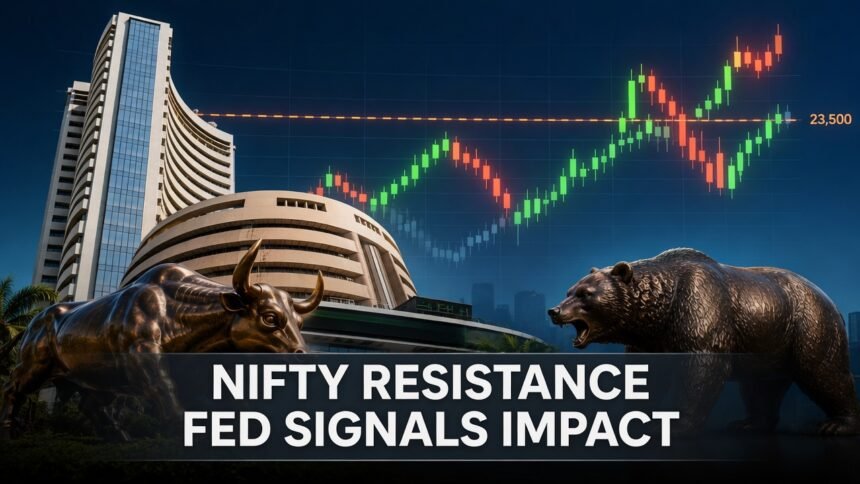
Indian equity markets remain sensitive to global cues following a period of heightened volatility, with the Nifty 50 facing resistance around the 23,300–23,500 zone. Recent technical commentary has identified 23,300–23,400 as an immediate hurdle, while 23,500–23,600 remains a more important resistance area.
Investor attention is also focused on the US Federal Reserve’s interest-rate outlook, after the US central bank raised its policy rate by 25 basis points and indicated that another increase could remain possible later in the year. The shift in US monetary policy has implications for global liquidity, bond yields, currencies and emerging-market equities, including India.
Nifty 50 Remains in a Volatile Trading Range
The Nifty 50 has experienced significant swings in recent sessions. On September 17, the index closed at 23,270.6, gaining 0.23%, although the broader market remained sensitive to global monetary-policy and oil-price developments.
Technical analysts have pointed to the 23,100–23,000 region as important support, while the 23,300–23,400 zone has emerged as immediate resistance. A move beyond 23,500–23,600 would represent a more significant technical test.
The market’s ability to sustain gains above these levels could therefore remain an important focus for traders in the coming sessions.
23,300–23,500 Zone Becomes Key Resistance
The Nifty resistance 23,300–23,500 zone has gained importance after the recent correction.
According to technical views reported by Moneycontrol, 23,300–23,400 is an immediate hurdle, while 23,500–23,600 is another significant resistance band. Analysts have also identified 23,050–23,000 as an important support region.
This creates a relatively defined near-term range for the index:
- Immediate resistance: 23,300–23,400
- Major resistance: 23,500–23,600
- Key support: 23,100–23,000
- Further downside reference: around 22,900
These levels are technical reference points cited by market analysts rather than guaranteed future price targets.
US Federal Reserve Remains a Major Market Driver
The latest Federal Reserve decision has added another layer of uncertainty for global markets.
On September 16, the US Federal Reserve raised its benchmark interest rate by 25 basis points to a target range of 3.75%–4.00%. The decision marked the Fed’s first rate increase in more than three years. Its updated projections also showed that 16 of 18 policymakers expected at least one additional rate increase before the end of 2026.
For Indian equities, higher US interest rates can affect global capital flows and the relative attractiveness of emerging-market assets. The stronger dollar and higher US Treasury yields can also put pressure on emerging-market currencies and financial conditions.
Reuters reported that Indian equities remained largely subdued following the Fed decision, with the Nifty ending September 17 at 23,270.6 as investors assessed the implications of the central bank’s more hawkish stance.
Why Fed Cues Matter for Indian Stocks
US monetary policy has a broad influence on global financial markets.
When US interest rates remain elevated or are expected to rise further, international investors may reassess allocations between US assets and emerging markets. Changes in US Treasury yields can also influence borrowing costs and currency movements globally.
For India, the impact can extend to:
- Foreign portfolio investment flows
- Rupee-dollar movements
- Indian bond yields
- Banking and financial stocks
- Technology companies with significant overseas exposure
- Overall market liquidity and risk appetite
Recent market commentary has highlighted the Fed’s policy path, crude oil prices, global bond yields and foreign flows as important drivers for Indian equities.
Rupee and Crude Oil Add to Market Concerns
The Federal Reserve is not the only factor influencing Indian markets.
Crude oil prices have remained elevated amid geopolitical tensions and supply concerns. Reuters reported Brent crude around the $100-per-barrel level during the week, while earlier in the week prices had moved above $108.
Higher crude prices can be particularly important for India because the country relies heavily on imported oil. An extended increase can affect the trade balance, inflation expectations and the rupee.
The Indian currency also faced pressure following the Fed’s rate decision. The rupee briefly moved beyond ₹96 per US dollar on September 17 before recovering, with Reuters reporting probable RBI intervention and portfolio inflows supporting the currency.
Broader Equity Markets Remain Sensitive
The recent volatility has not been limited to the Nifty 50.
On September 17, small- and mid-cap indices recorded gains even as the benchmark indices remained mixed. Reuters noted that 12 of 16 sectoral indices advanced during the session, indicating that market participation remained uneven rather than uniformly negative.
The divergence suggests that investors continue to differentiate between sectors and individual companies even as macroeconomic uncertainty remains elevated.
Technology stocks, for example, can be particularly sensitive to US financial conditions because the United States represents an important market for Indian software exporters.
What Traders Are Watching Next
The next phase of market movement is likely to be closely watched around both technical levels and global macroeconomic signals.
On the technical side, analysts are monitoring whether the Nifty can sustain itself above the 23,300 area and eventually challenge the 23,500–23,600 zone. On the downside, the 23,100–23,000 region remains an important support area.
On the macroeconomic side, investors are likely to monitor further comments from Federal Reserve officials, US inflation and economic data, Treasury yields, crude oil prices and currency movements.
The Fed’s decision to leave open the possibility of another rate increase means upcoming economic data and central-bank commentary could remain important for global markets.
Looking Ahead
The Nifty resistance 23,300–23,500 zone remains a key technical area as Indian equities navigate elevated global uncertainty. Recent analyst commentary places immediate resistance around 23,300–23,400 and a stronger hurdle around 23,500–23,600, while 23,000–23,100 remains an important support region.
At the same time, the Federal Reserve’s latest rate decision, the outlook for further US rate increases, crude oil prices and rupee movements are likely to remain important market variables.
For investors, the combination of technical resistance and global macroeconomic signals means market direction could continue to depend heavily on incoming data and policy developments rather than a single factor.
Frequently Asked Questions
1. What is the current Nifty resistance level?
Recent technical analysis has identified 23,300–23,400 as immediate resistance, with 23,500–23,600 acting as a stronger hurdle.
2. What is the key support level for Nifty?
Analysts have identified the 23,000–23,100 zone as an important support area for the Nifty 50.
3. Why is the Federal Reserve important for Indian stocks?
US Federal Reserve decisions influence global interest rates, Treasury yields, the US dollar, international capital flows and overall investor risk appetite, all of which can affect Indian equities.
4. What did the US Federal Reserve recently do?
The Federal Reserve raised its policy rate by 25 basis points to 3.75%–4.00% on September 16, 2026.
5. Could another Fed rate hike affect Indian markets?
Another US rate increase could influence global yields, the dollar and capital flows into emerging markets. The actual market impact would depend on the size and timing of the move and how investors interpret the accompanying economic data and policy guidance.
6. Why are crude oil prices important for Indian markets?
India imports a large amount of its crude oil requirements, so sustained increases in oil prices can affect inflation, the trade balance, the rupee and corporate costs.
7. What happened to the rupee after the Fed decision?
The rupee briefly weakened beyond ₹96 per US dollar on September 17 before recovering, with Reuters reporting probable RBI intervention and portfolio inflows.
8. Is the broader Indian market also volatile?
Yes. Recent sessions have featured sharp movements in benchmark indices alongside varying performances across small-, mid-cap and sectoral indices.
9. What levels are traders watching on the Nifty?
The main levels highlighted by recent technical analysis are 23,000–23,100 on the downside and 23,300–23,600 on the upside.
10. What could influence Nifty’s next move?
Key factors include Federal Reserve policy signals, US economic data, crude oil prices, Treasury yields, rupee movements, foreign investment flows and the Nifty’s ability to move through its technical resistance levels.