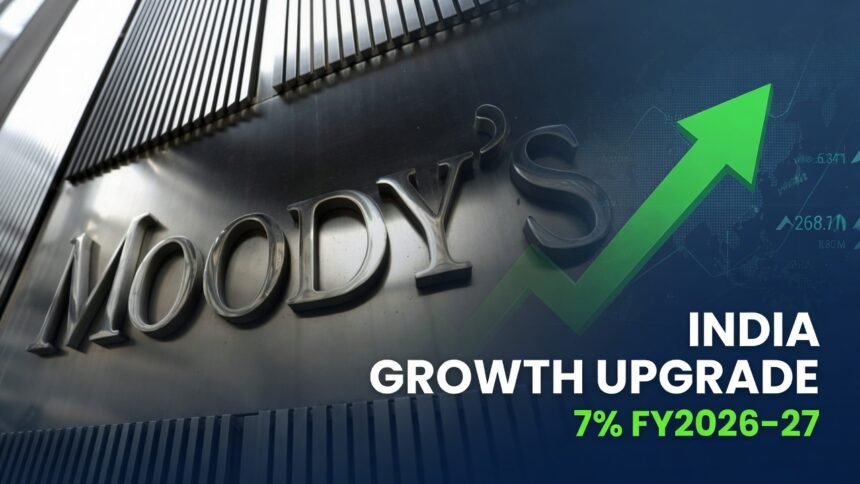
Moody’s Upgrades India’s Growth Forecast to 7% for FY2026-27
Moody’s upgrades India’s growth forecast for the current financial year, raising its real GDP projection to 7% from an earlier estimate of 6%. The ratings agency cited stronger-than-expected economic momentum and India’s resilience despite ongoing global and geopolitical challenges.
The revision comes as India’s economy continues to show strength in domestic consumption, investment and services. However, Moody’s also warned that elevated energy prices and potential food inflation linked to El Niño could pose risks to the outlook.
Moody’s Raises India GDP Forecast to 7%
Moody’s Ratings has increased its real GDP growth forecast for India’s fiscal year 2026-27 to 7%, marking a one-percentage-point increase from its previous 6% projection.
The revised estimate reflects the agency’s assessment that India’s economic activity has remained resilient despite external pressures, including the ongoing conflict in the Middle East.
The latest projection also places India’s expected growth above forecasts from several other major international institutions. The Economic Times reported that Moody’s new estimate is higher than earlier projections from the IMF and S&P Global.
Strong Domestic Demand Supports the Outlook
One of the key factors behind Moody’s more optimistic forecast is India’s domestic economic momentum.
The agency pointed to stronger private consumption as an important driver of growth. Robust investment, particularly capital formation supported by public infrastructure spending, is also contributing to economic activity.
A potential revival in private-sector investment could provide another source of growth if businesses continue increasing capital expenditure.
India’s large domestic market also provides some insulation from weaker external demand, allowing economic activity to remain supported even when global conditions become more uncertain.
India’s Economy Shows Resilience Amid Global Headwinds
The upgrade comes against a challenging global backdrop.
The ongoing Middle East conflict has contributed to volatility in energy markets, while elevated crude oil prices have increased concerns about inflation and import costs for oil-dependent economies.
Despite these pressures, Moody’s assessment is that India’s economy has demonstrated resilience.
The ratings agency expects India to continue growing faster than other G20 economies and similarly rated emerging-market sovereigns.
This assessment reflects the continued contribution of domestic demand, investment and services activity to overall economic growth.
India’s Recent GDP Performance
The upgraded forecast follows strong recent GDP performance.
India’s real GDP expanded by 7.7% in fiscal 2025-26, according to reports citing Moody’s latest assessment. This followed growth of 7.1% in the previous fiscal year.
The April-June quarter also recorded 7.8% year-on-year growth, with investment and manufacturing activity contributing strongly to the expansion.
The latest data helped reinforce the view that economic momentum remained stronger than previously anticipated.
Services Sector Remains an Important Growth Driver
India’s services sector continues to play an important role in the country’s economic expansion.
Moody’s has pointed to sustained strength in services as one of the factors supporting its improved growth outlook.
India’s large services economy includes information technology, financial services, business services, telecommunications, trade and other professional activities.
Continued activity across these sectors can support employment, household income and domestic consumption while also contributing to India’s export earnings.
Investment Activity Adds to Growth Momentum
Investment is another major component of the revised outlook.
Public infrastructure spending has supported capital formation, while Moody’s expects private-sector investment to potentially strengthen as economic conditions remain supportive.
Infrastructure development across transport, manufacturing, energy and other sectors can have wider economic effects by creating demand for construction, industrial goods, financial services and employment.
The strength and sustainability of private investment will therefore remain an important factor for India’s medium-term growth trajectory.
Energy Prices Remain a Major Risk
Despite raising its forecast, Moody’s has highlighted risks from elevated energy prices.
India is a major importer of crude oil, meaning a prolonged period of high global oil prices can increase import costs and put pressure on inflation, the current account and government finances.
Reuters reported that Moody’s expects higher energy costs could potentially require greater government subsidies or additional fiscal support if the disruption continues.
Higher energy prices can also affect household purchasing power and business costs, creating a potential drag on consumption and investment.
El Niño Could Add Inflation Pressure
Another risk identified by Moody’s is the possibility of El Niño-related food inflation.
Weather disruptions can affect agricultural output and food prices, which can have a direct impact on household consumption and overall inflation.
Moody’s therefore cautioned that higher food and energy prices could create challenges for India’s growth outlook even as the underlying economy remains resilient.
The combination of energy and food-price pressures will remain an important factor for policymakers and businesses to monitor.
Growth Forecast Compared With Other Estimates
Moody’s revised 7% forecast is relatively strong compared with other recent projections.
The agency’s latest estimate is above the 6.6% growth projection previously issued by the Reserve Bank of India for FY2026-27 and also exceeds projections from the IMF and S&P Global cited in recent reports.
Differences between forecasts are normal because institutions use different assumptions about global growth, inflation, energy prices, investment and domestic consumption.
The actual pace of growth will ultimately depend on how these factors evolve throughout the financial year.
What the Upgrade Means for India’s Economy
The upward revision provides an external assessment of India’s continued economic momentum.
A higher growth forecast can influence expectations around corporate earnings, investment, employment and consumer demand. It can also contribute to international investor interest in India’s economy.
At the same time, the forecast is not without risks. Higher energy prices, food inflation, geopolitical uncertainty and fiscal pressures could affect economic activity if they persist.
Therefore, the revised 7% projection should be viewed as a forecast based on current economic conditions rather than a guaranteed outcome.
Looking Ahead
Moody’s decision to raise India’s real GDP growth forecast from 6% to 7% for FY2026-27 reflects stronger domestic economic momentum and resilience amid global headwinds.
Private consumption, infrastructure-led investment and services activity are expected to remain important growth drivers. India’s strong recent GDP performance has also contributed to the more optimistic outlook.
However, energy prices and potential El Niño-related food inflation remain significant risks. The trajectory of crude oil prices, inflation, private investment and global economic conditions will therefore be important in determining whether India’s economy maintains the momentum reflected in Moody’s latest forecast.
FAQs
1. What is Moody’s latest India GDP growth forecast?
Moody’s has raised India’s real GDP growth forecast for FY2026-27 to 7% from its earlier estimate of 6%.
2. Why did Moody’s raise India’s growth forecast?
Moody’s cited India’s economic resilience, stronger private consumption, robust investment and continued strength in the services sector.
3. What was Moody’s previous growth forecast for India?
Moody’s previously projected India’s real GDP growth at 6% for FY2026-27.
4. What is India’s fiscal year 2026-27?
India’s FY2026-27 runs from April 1, 2026, through March 31, 2027.
5. What are the major drivers of India’s growth?
Private consumption, infrastructure investment, private-sector investment and services activity are among the major factors supporting the current growth outlook.
6. What risks could affect India’s growth forecast?
Moody’s has highlighted elevated energy prices and potential El Niño-related food inflation as important risks to consumption and economic growth.
7. How fast did India’s economy grow in FY2025-26?
India’s real GDP grew by 7.7% in FY2025-26, according to figures cited in reports on Moody’s latest forecast.
8. How did India’s economy perform in the April-June quarter?
India’s economy grew 7.8% year-on-year in the April-June quarter, supported by investment and manufacturing activity.
9. Is Moody’s 7% forecast higher than some other projections?
Yes. Recent reports said Moody’s 7% forecast is above earlier projections from the IMF, S&P Global and the Reserve Bank of India.
10. Will India definitely grow by 7% in FY2026-27?
No. The 7% figure is Moody’s forecast based on current conditions and assumptions. Changes in energy prices, inflation, investment, consumption and global economic conditions could affect actual growth.