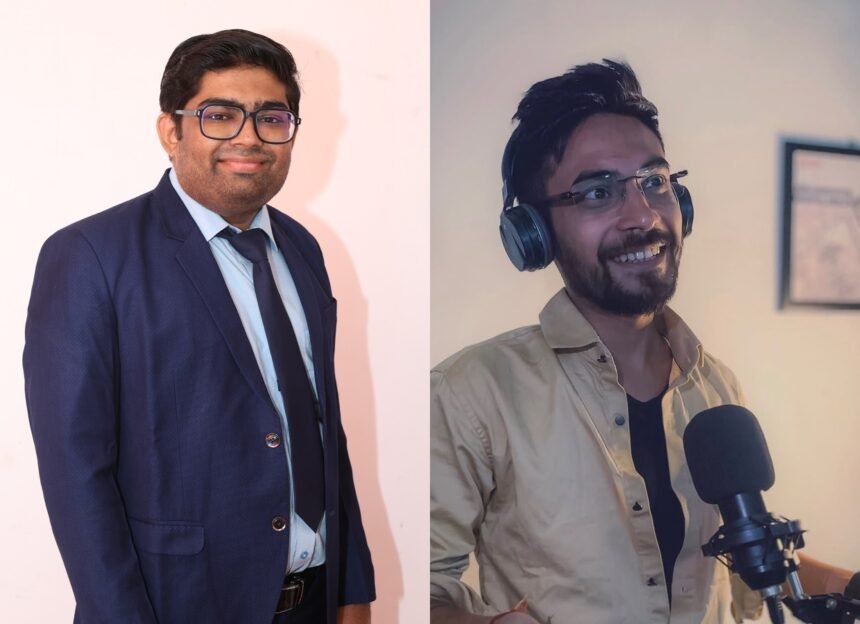
Its co-founders come from Akola and Jaipur, not Bengaluru. But Vaibhav Palhade and Pratyush Shrivastava are attempting something the city’s SaaS veterans will recognise: building software for global customers, from scratch, on a problem most companies have not yet noticed.
Most founders, asked how their company began, describe a moment of inspiration. Vaibhav Palhade and Pratyush Shrivastava describe a list.
It was a list of things that had gone wrong. Palhade, an engineer, filmmaker and author from Akola in Maharashtra, had three or four earlier ventures that did not survive. Shrivastava, a technologist from Jaipur, had run a startup of his own that also closed. When the two began working together, they spent their first meetings comparing failures rather than ideas.
“It was not a cheerful way to start a company,” Palhade says. “But it was the most useful conversation we had.”
That conversation stretched into roughly two to three years of research before Marketing Kernal Private Limited was formally established in 2026. The company works on what is increasingly called AI visibility: how businesses are found, described and recommended inside answers produced by AI assistants such as ChatGPT, Gemini, Perplexity and Google’s AI Overviews.
A problem hiding in plain sight
The founders’ argument rests on a shift that is already visible in the data. In February 2024, the research firm Gartner predicted that traditional search engine volume would fall by 25 per cent by 2026, as people turned to AI chatbots and virtual agents. Whether or not that exact figure holds, the behaviour behind it is spreading.
For businesses, the change is subtle but significant. A search engine produces a list and leaves the choice to the customer. An AI assistant often makes the shortlist itself, then explains its reasoning in a few sentences.
“Most companies can tell you where they rank on Google,” Shrivastava says. “Almost none can tell you whether ChatGPT mentions them, or what it says. That is a strange blind spot for something that is shaping buying decisions.”
Two people, two halves
The partnership divides cleanly. Palhade leads marketing, product and go-to-market. Shrivastava leads technology and infrastructure. Both describe the split as the most deliberate decision they made.
Palhade’s route to software was unusual. After engineering, he began as an assistant writer and director, went on to write screenplays and dialogue for Hindi films, series and Marathi daily soaps, and saw several of his social-theme films win awards. His novels, the most recent being Echoes of Yesterday in 2024, brought him a wider readership. Alongside that, he spent years in hands-on search and digital marketing work for software companies selling overseas.
“Film teaches you how quickly an audience decides,” he says. “Search data teaches you that the audience is usually right.”
Shrivastava thinks in systems and speaks in short sentences. “Vaibhav starts with the customer’s story,” he says. “I start with what the database can prove. We meet somewhere in the middle.”
Not quite an agency
Marketing Kernal currently sells services, including AI visibility audits, entity SEO and digital PR. But the founders resist the label of agency. They describe the services as a way of learning what works before turning it into software.
That software is being developed as a family of products under the Kernal name. The first, Outreach Kernal, is a B2B prospecting tool built around verified data and careful buyer research, with a beta version planned for November. The founders are guarded about the rest, describing them only as covering AI visibility tracking and sales conversations, with tools for creative professionals, including filmmakers, to follow.
The ambition is a connected system in which visibility, prospecting and conversations share the same view of a customer, rather than sitting in separate tools that never exchange information. It is a crowded idea in a crowded market, and the founders do not pretend otherwise.
In practice, the founders say, their work starts with a simple and slightly uncomfortable exercise: asking the AI assistants a company’s buyers actually use about that company’s category, across markets and languages, and recording what comes back. Which businesses are named? How is the client described, if at all? Which sources does the assistant cite? The answers are then compared with how the company describes itself.
“The gap is usually bigger than people expect,” Palhade says. “Sometimes the description is out of date. Sometimes it belongs to a competitor. Occasionally it is simply wrong. You cannot fix any of that until you have seen it.”
The Bengaluru question
Bengaluru built much of India’s SaaS industry on a simple proposition: write software in India, sell it to the world. Marketing Kernal follows the same model from outside the metros, targeting businesses in the United States, Britain, the UAE, Canada and Australia as well as India.
There is a regulatory angle too. Europe’s GDPR and the EU AI Act set strict expectations for how data and AI can be used, and the founders say compliance is designed into their products rather than added later.
“In our category, a lot of firms promise results they cannot control,” Shrivastava says. “We would rather be boring about compliance and honest about what can be measured.”
What could go wrong
The risks are real, and the founders list them without prompting. The field is young. AI answers change frequently and are hard to measure consistently. Larger, better-funded companies are moving into the same space. And Marketing Kernal is still early, with its products at different stages of readiness.
The company has not published client case studies. Palhade says that is intentional. “We will publish numbers when we have numbers we can defend,” he says. “Not before.”
Asked what three years of research and several failures taught them, the two founders answer in the same breath. Validate before building, says Shrivastava. Choose quality over volume, says Palhade.
Then Palhade adds a third. “Do not confuse being busy with making progress,” he says. “We were very busy, the first few times.”