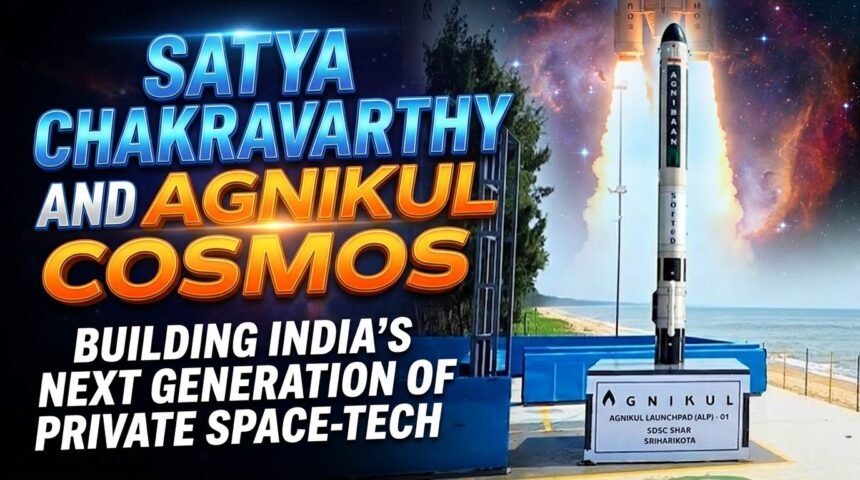
Satya Chakravarthy Agnikul Cosmos: Building India’s Next Generation of Private Space-Tech
Satya Chakravarthy Agnikul Cosmos is a name increasingly associated with India’s rapidly evolving private space sector. Through Agnikul Cosmos, Chakravarthy is working on launch technology designed to make access to space more flexible and affordable, particularly for the growing small-satellite market.
India’s space industry is no longer limited to government-led missions. A new generation of private companies is developing rockets, satellites and other technologies that could change how commercial customers access space.
Agnikul Cosmos is part of this transformation, with a focus on highly customizable launch vehicles for small satellites.
Who Is Satya Chakravarthy?
Satya Chakravarthy is associated with Agnikul Cosmos, an Indian space-tech company working on launch vehicles for the commercial space market.
His work comes at a time when India’s private space ecosystem is expanding rapidly.
The opening of the space sector to private companies has created opportunities for startups to develop technologies that were previously concentrated largely within government institutions.
Agnikul Cosmos is attempting to take advantage of this shift by developing launch systems aimed at the needs of smaller satellite customers.
What Is Agnikul Cosmos Building?
Agnikul Cosmos is developing small satellite launch vehicles designed to provide customers with more flexible access to space.
The traditional satellite-launch market has often involved large rockets carrying multiple satellites at once.
While this approach can be efficient, smaller satellite companies may have less control over when and where their spacecraft are launched.
A dedicated small-launch vehicle can potentially offer greater flexibility.
This is where Agnikul Cosmos sees an opportunity.
Why Small Satellite Launch Vehicles Matter
Small satellites have become increasingly important across industries.
They are being used for communications, Earth observation, agriculture, climate monitoring, navigation and other applications.
As satellite technology becomes smaller and more affordable, more startups and businesses are entering the space sector.
But launching a satellite remains one of the biggest challenges.
A launch vehicle designed specifically for smaller payloads could help customers access orbit without having to depend entirely on larger rockets.
This creates a potentially important market for companies such as Agnikul Cosmos.
The Importance of Customizable Launch Vehicles
One of the key ideas behind Agnikul Cosmos is customization.
Different satellite operators have different requirements.
They may need different orbital destinations, launch schedules or payload configurations.
A highly customizable launch vehicle can potentially give customers greater control over their missions.
For commercial satellite operators, this flexibility can be valuable because timing is often critical.
Instead of waiting for a suitable slot on a larger shared launch, customers could potentially choose a launch service better suited to their specific requirements.
Making Access to Space More Affordable
Cost remains one of the biggest barriers to entering the space industry.
Launching a satellite requires significant investment, particularly for startups and smaller businesses.
Private launch companies are trying to reduce this barrier by developing rockets and launch systems that can operate more efficiently.
Agnikul Cosmos’s focus on small satellite launch vehicles is therefore connected to a larger objective: making access to space more affordable and accessible.
If launch costs decline and launch availability improves, more companies could experiment with satellite-based technologies.
India’s Private Space Sector Is Changing
India’s space sector has historically been dominated by government institutions, particularly the Indian Space Research Organisation (ISRO).
That landscape is changing.
Private space startups are now developing launch vehicles, satellite technologies and other aerospace systems.
This has created a new ecosystem where entrepreneurs, engineers and investors can work on commercial space applications.
Agnikul Cosmos is one of the companies helping demonstrate what India’s private space industry can build.
Why Agnikul Cosmos Is Important
The significance of Agnikul Cosmos goes beyond a single rocket or launch mission.
The company represents a broader shift towards commercial space technology in India.
A strong private launch ecosystem could create new opportunities for satellite companies, research institutions and businesses.
It could also generate highly skilled jobs and encourage the development of advanced technologies in areas such as propulsion, materials, software and aerospace engineering.
The Growing Global Small-Satellite Market
The global space industry is seeing increasing demand for small satellites.
Smaller spacecraft can be developed faster and often cost less than traditional large satellites.
This has opened space applications to companies that previously could not afford to participate.
However, the growth of small satellites also creates demand for reliable and flexible launch services.
This is the market that companies like Agnikul Cosmos are trying to serve.
Challenges Ahead for Agnikul Cosmos
Building a launch vehicle is an extremely complex engineering challenge.
Rocket companies need to deal with propulsion, structural design, avionics, testing, manufacturing and launch operations.
Reliability is especially important.
A satellite operator may spend years developing a spacecraft, making a successful launch absolutely critical.
Agnikul Cosmos will therefore need to demonstrate that its launch technology can operate reliably and economically as it moves towards larger commercial opportunities.
Why Satya Chakravarthy’s Work Matters
The Satya Chakravarthy Agnikul Cosmos story reflects India’s growing ambitions in space technology.
The goal is not simply to participate in the global space industry but to develop technologies that can compete in a rapidly changing commercial market.
Affordable and flexible launch services could make it easier for more Indian and international companies to put satellites into orbit.
That could ultimately contribute to the growth of India’s wider space-tech ecosystem.
What Could the Future Look Like?
If private launch companies successfully scale their operations, access to space could become more similar to other commercial technology services.
Customers could have more choices when selecting launch providers, schedules and mission configurations.
For small satellite operators, this could mean greater flexibility and potentially lower costs.
For India, the growth of private launch companies could strengthen the country’s position as a global destination for commercial space technology.
Frequently Asked Questions (FAQs)
1. Who is Satya Chakravarthy?
Satya Chakravarthy is associated with Agnikul Cosmos and India’s emerging private space-tech ecosystem.
2. What is Agnikul Cosmos?
Agnikul Cosmos is an Indian space-tech company developing small satellite launch vehicles aimed at providing flexible and affordable access to space.
3. What does Agnikul Cosmos focus on?
The company focuses on developing launch vehicles that can support smaller satellite missions and provide customers with greater customization and flexibility.
4. Why are small satellite launch vehicles important?
Small satellite launch vehicles can provide dedicated or more flexible launch opportunities for smaller spacecraft, potentially reducing dependence on larger shared launches.
5. What is customizable access to space?
Customizable access to space means allowing customers greater flexibility around factors such as payload configuration, mission requirements and launch planning.
6. Why is India’s private space sector growing?
Policy changes and increased private participation have created opportunities for Indian startups to develop commercial launch vehicles, satellites and other space technologies.
7. What challenges does Agnikul Cosmos face?
The company faces major technical and commercial challenges, including rocket reliability, testing, manufacturing, launch operations, regulatory requirements and controlling costs.
8. Why is Satya Chakravarthy’s work significant?
The Satya Chakravarthy Agnikul Cosmos story highlights India’s transition towards a stronger private space industry and the effort to make satellite launches more flexible and affordable.