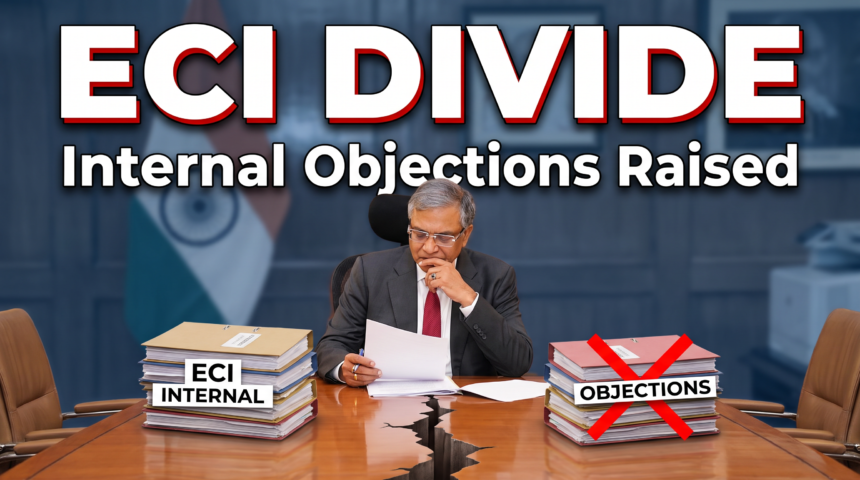
ECI Internal Row: Two Election Commissioners Raise 14 Objections Over 10 Months
An internal disagreement within the Election Commission of India (ECI) has come to light after an investigation by The Indian Express reported that two Election Commissioners formally raised objections at least 14 times over a period of 10 months to decisions and orders issued in the poll panel’s name.
The objections were reportedly made by Election Commissioners Sukhbir Singh Sandhu and Vivek Joshi, with several relating to electoral-roll management, voter registration, deletion and restoration of names, and the technology used to maintain voter databases. Some of the objections described certain actions as “unauthorised” and “illegal.”
The report has brought renewed attention to the functioning of the three-member Election Commission, particularly during the ongoing debate surrounding the Special Intensive Revision (SIR) of electoral rolls.
What the Indian Express Investigation Reported
According to The Indian Express, Sandhu and Joshi placed objections on record at least 14 times during the previous 10 months, including four objections on a single day.
The newspaper reported that the two Commissioners said some decisions had been taken without their knowledge. The issues reportedly covered new voter registration, deletion and restoration of names from electoral rolls, appeals against voter deletions and control over the electoral-roll database.
The objections were also copied to Chief Election Commissioner Gyanesh Kumar, according to the investigation.
The report said the disagreements became particularly significant because they concerned areas at the centre of the ECI’s constitutional and statutory responsibilities.
Dispute Over Changes to Form 6
One of the reported disagreements concerned Form 6, which is used by eligible citizens to apply for inclusion in the electoral roll.
According to the investigation, a new declaration was added to Form 6 on the ECI’s ECINet portal. Applicants were asked to indicate whether their name, or the name of a parent or grandparent, had appeared in an electoral roll during an earlier Special Intensive Revision.
Sandhu and Joshi had reportedly raised concerns about the change. The investigation quoted Sandhu as subsequently describing the change as “unauthorised and illegal” and calling for its immediate removal.
The report also said the two Commissioners had earlier indicated that changing the form in this manner required an amendment to the relevant rules.
Concerns Over Centralised Electoral Database
Another major issue involved the technology infrastructure used for electoral rolls.
The Election Commission traditionally operates through Electoral Registration Officers (EROs), who have statutory responsibilities at the constituency level. According to The Indian Express, the two Commissioners questioned whether access and control over electoral-roll data were increasingly being centralised through the ECI’s technology systems in Delhi.
The report highlighted concerns about ERONet and ECINet, the digital systems used in the electoral-roll process.
The investigation reported that the Commissioners were concerned that centralised controls could limit the ability of local electoral officers to implement decisions relating to voter registration and electoral-roll corrections.
Goa Voter Registration Issue
The investigation also pointed to a case in Goa involving 97 voters.
According to the report, Electoral Registration Officers had found the applicants eligible after examining their documents, but the relevant software reportedly prevented those decisions from being recorded in the system.
The episode became part of the broader concerns raised about the relationship between statutory officers working at the ground level and centralised technology systems operated by the Election Commission.
West Bengal Appeals Also Raised Questions
The reported disagreements also extended to the handling of appeals involving deleted voters in West Bengal.
The Indian Express investigation said concerns were raised about the process through which appeals against voter deletions were handled during the SIR exercise.
These issues are significant because electoral-roll revisions involve decisions that can determine whether eligible citizens remain on the voter list and are able to participate in elections.
What Is the Special Intensive Revision?
The Special Intensive Revision (SIR) is an exercise conducted by the Election Commission to review and update electoral rolls.
The process has involved verification of voter records and action concerning entries considered to involve deceased, shifted, duplicate or otherwise ineligible voters. The exercise began in Bihar and subsequently expanded to other parts of the country.
According to The Indian Express, the national rollout has affected voter records across numerous states and Union Territories, putting the ECI’s procedures for adding, deleting and restoring names under considerable public scrutiny.
Election Commission Rejects Claim of Internal Disagreement
The Election Commission has disputed the characterization of the reported objections as evidence of an internal breakdown.
According to Hindustan Times, ECI sources said that all decisions taken by the Commission, including those concerning SIR, had the approval of all three Election Commissioners.
The Commission’s position was that the decisions were unanimous and had the approval of CEC Gyanesh Kumar, Sukhbir Singh Sandhu and Vivek Joshi.
This response directly contrasts with the Indian Express investigation, which reported that Sandhu and Joshi had separately recorded objections to a number of decisions.
Why the ECI Internal Row Matters
The disagreement matters because the Election Commission is responsible for maintaining electoral rolls and administering elections across India.
Questions involving who can access voter databases, how new voters are registered, how names are deleted or restored and how appeals are processed can have direct consequences for voters.
The reported objections therefore concern not only administrative procedures but also the institutional structure through which electoral-roll decisions are implemented.
At the same time, the ECI’s response that its decisions were unanimous represents an important part of the dispute and should be considered alongside the findings reported by The Indian Express.
Concerns About Electoral Technology
The episode has also placed greater attention on the role of technology in India’s electoral administration.
Digital systems are increasingly central to maintaining voter databases, processing applications and implementing decisions made by election officials. The reported objections indicate that questions have emerged over how responsibilities are divided between central ECI technology systems and officials working at the state and constituency levels.
The Indian Express investigation described this as a question of whether the traditional decentralised safeguards built into electoral-roll management are being affected by greater centralisation of digital controls.
A Wider Debate Over ECI Functioning
The reported objections have triggered wider political and public debate about the functioning of the Election Commission.
Opposition leaders have reacted to the investigation and questioned the poll panel’s decision-making processes. These reactions are political responses to the reported internal objections rather than independent findings about the legality of the Commission’s functioning.
The ECI, meanwhile, has maintained that decisions taken by the Commission had the approval of all three Commissioners.
What Happens Next?
The controversy is likely to keep attention focused on the Election Commission’s procedures for electoral-roll management, particularly its use of digital systems and the implementation of SIR.
The central factual dispute is between the investigation’s account of formal objections recorded by two Commissioners and the ECI’s assertion that its decisions were approved unanimously.
Further documentation, official responses and judicial proceedings related to electoral-roll revisions may provide additional clarity on the issues raised in the investigation.
Frequently Asked Questions
1. What is the ECI internal row about?
The reported ECI internal row concerns objections allegedly raised by Election Commissioners Sukhbir Singh Sandhu and Vivek Joshi regarding several decisions related to electoral-roll management and the Special Intensive Revision.
2. How many objections were reportedly raised?
According to The Indian Express, the two Election Commissioners formally raised objections at least 14 times over 10 months.
3. Who are the two Election Commissioners involved?
The two Commissioners identified in the investigation are Sukhbir Singh Sandhu and Vivek Joshi.
4. Who is the Chief Election Commissioner?
Gyanesh Kumar is the Chief Election Commissioner of India and was identified in the investigation as the CEC to whom the objections were also copied.
5. What issues did the Commissioners reportedly object to?
The reported objections involved voter registration, electoral-roll deletions and restorations, appeals concerning deleted voters, changes to Form 6 and access to electoral-roll databases.
6. What is Form 6?
Form 6 is used by eligible citizens to apply for inclusion of their names in the electoral roll. The reported dispute involved changes to the information applicants were required to provide through the ECI’s digital platform.
7. What is SIR?
SIR stands for Special Intensive Revision, an electoral-roll revision exercise conducted by the Election Commission to verify and update voter records.
8. What did the ECI say about the reported disagreement?
ECI sources told Hindustan Times that all decisions of the Commission, including SIR-related decisions, had the approval of all three Election Commissioners and were unanimous.
9. What is ECINet?
ECINet is part of the Election Commission’s digital infrastructure used for electoral processes, including functions connected with electoral-roll management. The reported internal concerns included questions about centralised control of electoral-roll technology.
10. Why is this controversy significant?
The controversy is significant because the reported objections concern the management of voter registration, deletion and restoration of names and the technology supporting electoral rolls—functions directly connected to the administration of elections in India.