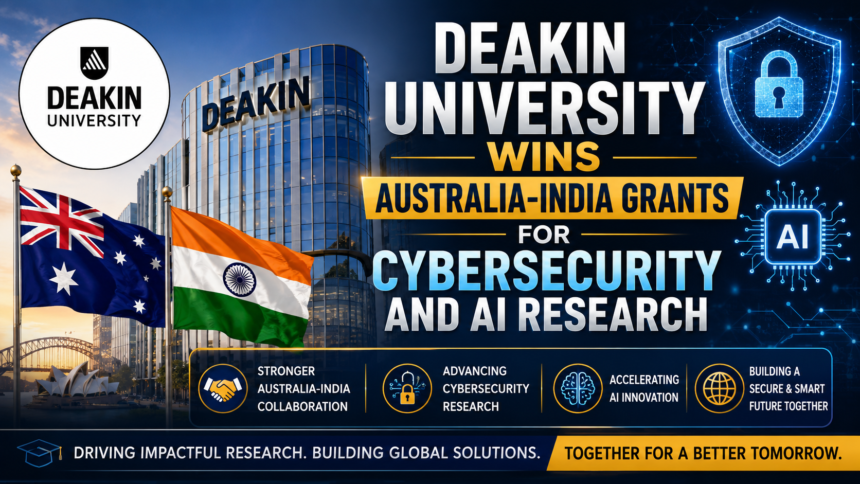
Deakin University India Grants Boost Australia-India Collaboration in Cybersecurity and AI
Deakin University India grants are set to support new research projects focused on cybersecurity, artificial intelligence and critical technology, strengthening the growing technology partnership between Australia and India.
Australia’s Deakin University has secured funding under the Australia-India Cyber and Critical Technology Partnership (AICCTP) for projects involving leading Indian institutions including IIT Madras, IIT Kanpur and Symbiosis International University.
The research will focus on two areas with growing strategic importance: Quantum-safe Digital Public Infrastructure and AI-driven secure energy supply chains.
The projects highlight how Australia and India are increasingly working together on technologies that could have a direct impact on digital security, critical infrastructure and future economic resilience.
Deakin University India Grants Mark a New Stage in Technology Cooperation
The Deakin University India grants come at a time when cybersecurity and artificial intelligence have become important priorities for governments and businesses around the world.
As more essential services move online, protecting digital infrastructure has become increasingly important.
At the same time, artificial intelligence is being introduced into industries ranging from finance and healthcare to manufacturing and energy.
The Australia-India partnership aims to bring together research capabilities from both countries to address some of these emerging challenges.
What Is the Australia-India Cyber and Critical Technology Partnership?
The Australia-India Cyber and Critical Technology Partnership, commonly known as AICCTP, is designed to encourage cooperation between Australia and India in cybersecurity and other critical technologies.
The partnership provides a platform for researchers, institutions and technology stakeholders from both countries to collaborate on emerging technological challenges.
The latest funding secured by Deakin University demonstrates how such partnerships can move beyond policy discussions and support practical research projects.
Quantum-Safe Digital Public Infrastructure
One of the key projects will focus on Quantum-safe Digital Public Infrastructure.
The term quantum-safe refers to technologies and security approaches designed to remain secure even as quantum computing becomes more capable.
Today’s encryption systems protect huge amounts of digital information.
However, advances in quantum computing could eventually threaten some of the cryptographic methods currently used to secure digital communications.
Preparing for that possibility is becoming an important area of cybersecurity research.
Why Quantum-Safe Security Matters
India has developed large-scale digital public infrastructure covering areas such as payments, identity and access to online services.
As digital systems become more deeply integrated into everyday life, protecting them from future cyber threats becomes increasingly important.
Quantum computing may still be developing, but security researchers are already working on ways to prepare for a future in which conventional encryption could face new challenges.
Research into quantum-safe infrastructure can therefore help countries identify potential vulnerabilities before they become urgent problems.
IIT Madras Joins the Research Effort
IIT Madras is among the Indian institutions involved in the research collaboration.
The institute has a strong presence across engineering, technology and scientific research.
Its participation can bring academic and technical expertise to the development of security approaches for digital public infrastructure.
Collaboration with international universities such as Deakin can also provide researchers with opportunities to combine different perspectives and research capabilities.
IIT Kanpur to Support AI and Security Research
IIT Kanpur is another major Indian institution participating in the collaboration.
The institute has expertise across engineering, computer science and technology research.
Its involvement in projects related to cybersecurity and AI can contribute to developing technologies designed for real-world critical infrastructure challenges.
Such partnerships can also help create stronger connections between academic research and practical technology applications.
Symbiosis International University Joins the Partnership
Symbiosis International University is also part of the India-focused research collaboration.
Its participation expands the academic network involved in the projects and demonstrates the broader role universities can play in international technology cooperation.
Research partnerships involving multiple institutions can help bring together expertise from different disciplines.
That becomes particularly useful when dealing with complex areas such as cybersecurity and artificial intelligence.
AI-Driven Secure Energy Supply Chains
The second major project focuses on AI-driven secure energy supply chains.
Energy infrastructure is one of the most critical components of any modern economy.
Power generation, transmission, distribution and related supply chains increasingly rely on digital systems.
This creates opportunities for AI to improve efficiency and forecasting, but it also creates new cybersecurity challenges.
The research aims to explore how AI can be used while maintaining the security and resilience of energy supply chains.
Why Energy Cybersecurity Is Important
Energy systems are increasingly connected through digital technologies.
Smart grids, automated controls, sensors and data-driven systems can improve efficiency and reliability.
However, greater connectivity can also increase the potential attack surface for cyber threats.
A successful cyberattack on critical energy infrastructure could have consequences beyond individual companies.
It could potentially affect businesses, households and essential services.
This makes cybersecurity a central consideration in the development of next-generation energy systems.
How AI Could Improve Energy Security
Artificial intelligence can analyse large volumes of data and identify unusual patterns much faster than traditional manual processes.
In energy infrastructure, AI could potentially help identify anomalies, detect suspicious activity and improve operational decision-making.
It can also support forecasting and help organisations respond more quickly to potential disruptions.
However, AI systems themselves must be protected.
This creates a need for research that looks at both the benefits of AI and the security challenges associated with deploying it in critical infrastructure.
Why Australia and India Are Working Together
Australia and India have increasingly expanded their cooperation across technology, education, cybersecurity and critical infrastructure.
Both countries have strong academic institutions and growing technology ecosystems.
International research partnerships can allow researchers to share knowledge, technical capabilities and practical experience.
For India, collaborations with Australian institutions can provide access to international research networks.
For Australia, working with Indian institutions provides an opportunity to engage with one of the world’s largest and fastest-growing digital economies.
Benefits for Indian Technology Research
The projects could provide several benefits for India’s technology ecosystem.
Researchers can gain opportunities to work on internationally relevant cybersecurity challenges.
Universities can build stronger global research relationships.
Students and early-career researchers can also gain exposure to advanced areas such as quantum-safe security and AI-driven critical infrastructure.
Over time, such collaborations can contribute to the development of specialised technical talent.
Importance for India’s Digital Future
India’s digital economy has expanded rapidly.
Digital payments, online government services, connected infrastructure and technology-driven businesses are now deeply integrated into everyday life.
This growth makes cybersecurity increasingly important.
The next stage of India’s digital development will require not only expanding digital services but also ensuring that the infrastructure supporting them remains secure and resilient.
Research into quantum-safe security and AI-driven infrastructure can contribute to that long-term objective.
The Growing Role of Deep-Tech Research
The projects also reflect a broader shift towards deep-tech research.
Rather than focusing only on consumer applications, researchers are increasingly working on technologies that address fundamental challenges in cybersecurity, infrastructure and national resilience.
Quantum-safe cryptography and AI-powered security systems are examples of technologies that may take years to develop but could have significant long-term impact.
International research partnerships can accelerate this process by bringing together specialised expertise.
What Comes Next?
The success of these Deakin University India grants will ultimately depend on how the research translates into practical solutions.
The projects could potentially lead to new security frameworks, technologies and approaches that can be tested and adopted by organisations in India and Australia.
The involvement of IIT Madras, IIT Kanpur and Symbiosis International University provides a strong academic foundation for the collaboration.
As cyber threats become more sophisticated and AI becomes increasingly embedded in critical infrastructure, partnerships of this kind could become even more important.
India-Australia Technology Cooperation Is Expanding
The latest projects show that the India-Australia relationship is moving deeper into advanced technology.
Cybersecurity, quantum-safe systems and AI-driven infrastructure are areas where research collaboration can have long-term strategic value.
For India, the partnership can support the development of secure digital infrastructure and specialised technical capabilities.
For Australia, it creates opportunities to collaborate with India’s extensive research and technology ecosystem.
The Deakin University India grants are therefore more than a funding announcement. They represent another step towards deeper Australia-India cooperation in technologies that will shape the future of the digital economy.
Frequently Asked Questions (FAQs)
1. What are the Deakin University India grants?
The Deakin University India grants refer to funding secured by Deakin University under the Australia-India Cyber and Critical Technology Partnership to support research projects with Indian institutions.
2. What is AICCTP?
AICCTP stands for the Australia-India Cyber and Critical Technology Partnership, which supports cooperation between Australia and India in cybersecurity and critical technologies.
3. Which Indian institutions are involved?
The projects involve IIT Madras, IIT Kanpur and Symbiosis International University.
4. What is the quantum-safe Digital Public Infrastructure project?
The project focuses on developing approaches to protect digital public infrastructure against future cybersecurity threats associated with advances in quantum computing.
5. Why is quantum-safe technology important?
Future quantum computers could potentially threaten some existing encryption methods. Quantum-safe technologies aim to prepare digital systems for this emerging security challenge.
6. What is the AI-driven energy supply chain project?
The project explores how artificial intelligence can be used to improve the security and resilience of energy supply chains while addressing the cybersecurity risks associated with increasingly digital infrastructure.
7. How can AI help protect energy infrastructure?
AI can potentially analyse large amounts of operational data, identify unusual patterns and help detect potential security threats more quickly.
8. Why is cybersecurity important for India’s digital infrastructure?
India increasingly relies on digital systems for payments, public services, businesses and critical infrastructure. Protecting these systems is essential for maintaining trust and operational resilience.
9. How could Indian students and researchers benefit?
International research projects can provide opportunities for students and researchers to work on advanced technologies, collaborate with overseas experts and develop specialised skills in cybersecurity and AI.
10. What does the collaboration mean for India and Australia?
The collaboration strengthens technology and research ties between the two countries while supporting work on cybersecurity, AI, quantum-safe systems and critical infrastructure security.