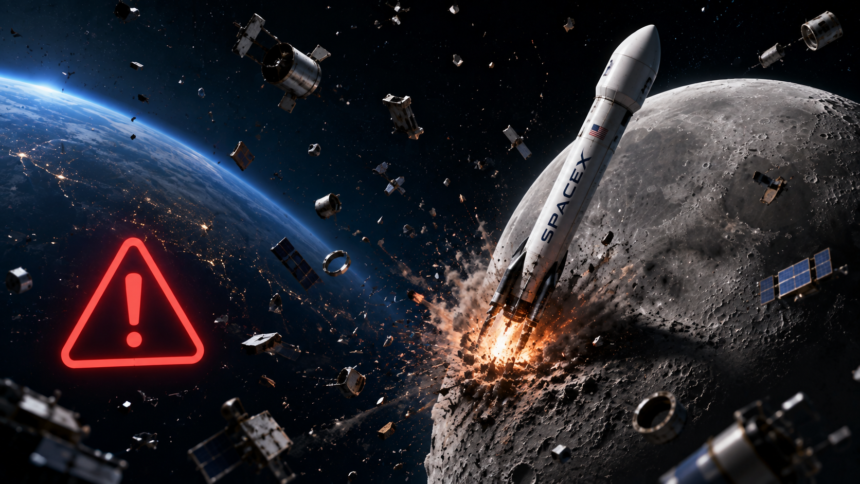
Astronomers are preparing for an unusual event as a discarded upper stage of a SpaceX Falcon 9 rocket is expected to collide with the Moon. Unlike planned lunar missions, this object was never intended to land on the lunar surface. While the impact presents a rare scientific opportunity to study collision dynamics, it also draws attention to a much larger issue facing the global space industry: space junk.
As more governments and private companies launch satellites and deep-space missions, managing abandoned spacecraft and rocket stages is becoming an increasingly important challenge.
Why the Falcon 9 Moon Crash Matters
The object involved is an upper stage from a Falcon 9 launch that has been traveling through space after completing its original mission. Instead of remaining in Earth orbit, it entered a trajectory that will eventually result in a collision with the Moon.
For scientists, the impact provides a natural experiment that can help improve understanding of:
- Lunar crater formation
- Impact physics
- Surface material behavior
- Ejecta patterns
- Future planetary defense research
Because the Moon has virtually no atmosphere, the rocket stage will strike the surface without burning up, creating a measurable impact.
A Scientific Opportunity
Researchers plan to observe the collision using telescopes and spacecraft whenever possible.
The data could help scientists:
- Improve computer models of high-speed impacts
- Understand how lunar soil reacts to collisions
- Compare artificial impacts with natural meteorite strikes
- Support future Moon exploration missions
Such events are uncommon, making them valuable for planetary science.
The Bigger Issue: Space Junk
Although this lunar impact has scientific value, it also highlights the growing problem of space junk.
Space junk refers to human-made objects that no longer serve a useful purpose in space, including:
- Defunct satellites
- Spent rocket stages
- Broken spacecraft components
- Collision fragments
- Mission debris
Thousands of these objects are currently orbiting Earth, creating increasing risks for operational satellites and future missions.
Why Orbital Debris Is a Serious Concern
The number of satellites in orbit has grown rapidly due to commercial space programs and satellite internet constellations.
If space debris continues to accumulate, it could lead to:
- Satellite collisions
- Damage to crewed spacecraft
- Disruption of communication networks
- Navigation system failures
- Higher mission costs
- Increased launch risks
Even small fragments traveling at extremely high speeds can cause severe damage to spacecraft.
The Role of Private Space Companies
Private aerospace companies have transformed the space industry by reducing launch costs and expanding access to space.
At the same time, experts argue that every organization launching spacecraft also shares responsibility for managing the debris left behind.
Many companies are already exploring solutions such as:
- Controlled deorbiting after missions
- Reusable rocket technology
- Space debris removal systems
- Improved mission planning
- Satellite end-of-life disposal strategies
These measures aim to reduce the long-term buildup of unnecessary objects in space.
The Future of Space Debris Management
Governments and international space agencies are increasingly working on stronger guidelines for responsible space operations.
Future policies may include:
- Mandatory debris mitigation plans
- Improved tracking of orbital objects
- Active debris removal missions
- International cooperation on space traffic management
- Stricter licensing requirements for satellite operators
As commercial space activity continues to expand, sustainable space operations will become increasingly important.
What This Means for Future Space Exploration
The upcoming SpaceX Falcon 9 Moon crash demonstrates both the opportunities and challenges created by modern space exploration.
While the collision offers valuable scientific insights into lunar impacts, it also reminds the global space community that every launch leaves behind objects that must eventually be managed responsibly.
Balancing innovation with sustainability will be essential as humanity prepares for larger lunar missions, Mars exploration, and thousands of additional satellite launches in the coming decades.
Final Thoughts
The expected SpaceX Falcon 9 Moon crash is more than an unusual astronomical event. It serves as a reminder that space is becoming increasingly crowded and that responsible debris management is now a critical part of modern space exploration.
As private space companies launch more missions than ever before, the focus is shifting beyond reaching space to ensuring it remains safe and sustainable for future generations.
FAQ
Why is the SpaceX Falcon 9 rocket stage crashing into the Moon?
The discarded upper stage completed its original mission and later entered a trajectory that is expected to result in a lunar impact.
Why are scientists interested in the impact?
The collision offers a rare opportunity to study impact physics, crater formation, and how the Moon’s surface responds to high-speed impacts.
What is space junk?
Space junk includes inactive satellites, spent rocket stages, broken spacecraft parts, and other human-made debris left in space after missions.
Why is orbital debris dangerous?
Space debris travels at extremely high speeds and can damage operational satellites, spacecraft, and other space infrastructure.
How can the space industry reduce space junk?
Experts recommend controlled deorbiting, reusable launch systems, debris removal technologies, improved tracking, and stronger international regulations.