Gaganyaan Life-Support Validation: ISRO Moves Ahead With Crew Module Safety Tests
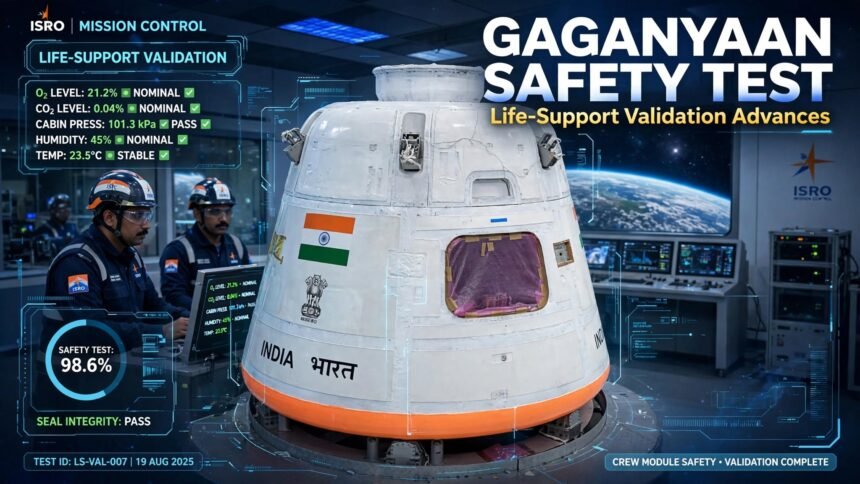
The Gaganyaan Life-Support Validation programme is entering another important phase as the Indian Space Research Organisation (ISRO) prepares additional ground-based recovery trials and environmental qualification tests for the crew orbital module.
The latest testing activity is part of India’s wider effort to validate the systems required to safely carry astronauts into space and bring them back to Earth.
ISRO Focuses on Crew Safety
Human spaceflight requires a much higher level of system reliability than conventional satellite missions.
For Gaganyaan, ISRO needs to demonstrate that the crew module can maintain suitable environmental conditions for astronauts throughout the mission while also performing reliably during launch, orbital operations, re-entry and recovery.
The latest life-support qualification work is therefore an important component of the overall human-spaceflight testing programme.
What Is Life-Support Validation?
A spacecraft’s life-support system is responsible for maintaining an environment in which astronauts can safely operate.
Among its key functions are managing atmospheric conditions, temperature and other environmental parameters inside the crew module.
The systems must continue operating reliably despite the demanding conditions associated with spaceflight.
Qualification testing allows engineers to assess these systems under controlled conditions and identify potential problems before crewed missions take place.
Environmental Qualification Tests
Environmental qualification is designed to determine whether spacecraft systems can withstand the conditions they are expected to experience during a mission.
The crew module can be exposed to different physical and environmental stresses during launch and spaceflight.
Testing helps engineers verify that critical equipment continues to function when subjected to those conditions.
For a human-rated spacecraft, this process is particularly important because failures involving the crew environment can directly affect astronaut safety.
Ground-Based Recovery Trials
Recovery is another major part of the Gaganyaan programme.
After completing its mission, the crew module must return through Earth’s atmosphere and eventually be recovered safely.
Ground-based recovery trials allow ISRO and associated teams to practice procedures and evaluate equipment used during the recovery phase.
These exercises can help identify operational gaps and improve coordination between spacecraft, recovery teams and support infrastructure.
Why Recovery Testing Matters
Successfully completing a space mission does not end when the spacecraft begins its return journey.
The crew module must survive atmospheric re-entry and reach a controlled recovery location. Once it reaches the sea or designated recovery area, astronauts need to be safely assisted and transported.
Recovery trials can therefore help test the practical procedures required after splashdown.
They also provide an opportunity to train personnel who may be responsible for locating, securing and assisting the crew module.
Gaganyaan’s Step-by-Step Approach
ISRO has been following a phased testing strategy for Gaganyaan rather than moving directly toward a crewed launch.
Uncrewed missions and ground-based tests allow engineers to evaluate individual systems and complete integrated testing before astronauts are placed inside the spacecraft.
This approach reduces risk by allowing technical issues to be identified and corrected during earlier stages.
The life-support and recovery tests form part of this broader validation process.
Crew Module at the Centre of the Programme
The crew orbital module is one of the most important components of Gaganyaan.
It is designed to provide the environment in which astronauts will live and operate during their mission.
The module must perform across multiple stages, from launch and orbital flight to re-entry and recovery.
Consequently, testing is not limited to a single system. Engineers must evaluate how different systems work together under mission-like conditions.
Importance for India’s Human Spaceflight Programme
Gaganyaan represents a major expansion of India’s spaceflight capabilities.
India has successfully developed and operated numerous satellites and launch vehicles, but sending humans into orbit introduces additional requirements involving crew safety, spacecraft reliability and emergency preparedness.
The testing programme is intended to build confidence in these capabilities before a crewed mission is attempted.
Successful qualification of life-support and recovery systems would represent another step toward that objective.
Technology and Engineering Challenges
Human-rated spacecraft have to deal with several demanding engineering challenges.
The spacecraft needs to maintain a controlled environment while operating in space, withstand launch vibrations and acceleration, protect the crew during re-entry and remain recoverable after landing.
Each of these stages requires separate validation.
This is why ISRO’s ground trials and qualification tests are as important as the eventual launch itself.
Ground Tests Support Future Crewed Flights
The information gathered from ground-based testing can help engineers improve spacecraft design and operational procedures.
If testing identifies weaknesses, modifications can be made before the next stage of the programme.
This iterative process is standard for complex human-spaceflight programmes because reliability is built through repeated testing rather than a single demonstration.
For Gaganyaan, every successful validation campaign can reduce uncertainty before astronauts eventually fly.
A Broader Milestone for ISRO
The latest testing activity also reflects the increasing complexity of India’s space programme.
Alongside satellite launches and scientific missions, ISRO is developing technologies for human spaceflight and future long-duration missions.
The expertise developed through Gaganyaan could eventually contribute to other human-spaceflight initiatives, including future orbital platforms and advanced crewed missions.
What Comes Next
The upcoming recovery trials and environmental qualification tests will provide additional data on the performance of Gaganyaan’s crew module and associated systems.
Further testing and uncrewed mission activities are expected before India proceeds toward its first crewed Gaganyaan flight.
The success of each stage will be important in establishing the reliability and safety standards required for human spaceflight.
Key Takeaway
The Gaganyaan Life-Support Validation programme marks another important step in India’s preparation for human spaceflight.
ISRO’s planned ground-based recovery trials and environmental life-support qualification tests are designed to validate critical systems before astronauts eventually fly.
By testing the crew module in stages and under demanding conditions, ISRO is working to reduce technical risks and build the reliability required for India’s first human spaceflight mission.
FAQs
1. What is Gaganyaan Life-Support Validation?
It refers to the testing and qualification of systems designed to maintain a safe environment for astronauts inside the Gaganyaan crew module.
2. What is the Gaganyaan mission?
Gaganyaan is India’s human-spaceflight programme, developed by ISRO to demonstrate the country’s capability to send astronauts into orbit and safely return them to Earth.
3. Why is life-support testing important?
Life-support systems are essential for maintaining suitable environmental conditions for astronauts during a space mission.
4. What are environmental qualification tests?
They are tests designed to verify that spacecraft systems can withstand the environmental and physical conditions expected during a mission.
5. What are ground-based recovery trials?
These are exercises used to test recovery equipment, procedures and coordination required to safely recover the crew module after its return.
6. Why is recovery important in Gaganyaan?
Astronaut safety depends not only on launch and orbital operations but also on a controlled re-entry and safe recovery after landing.
7. Will Gaganyaan systems be tested before astronauts fly?
Yes. ISRO is following a phased testing approach involving ground validation and uncrewed missions before a crewed flight.
8. What is the crew orbital module?
It is the spacecraft component designed to house and protect astronauts during the Gaganyaan mission.
9. How does testing reduce risks?
Testing allows engineers to identify technical or operational problems early and make improvements before crewed missions.
10. What should be watched next?
Upcoming recovery trials, environmental qualification tests and other Gaganyaan validation activities will be important milestones to watch as India progresses toward human spaceflight.