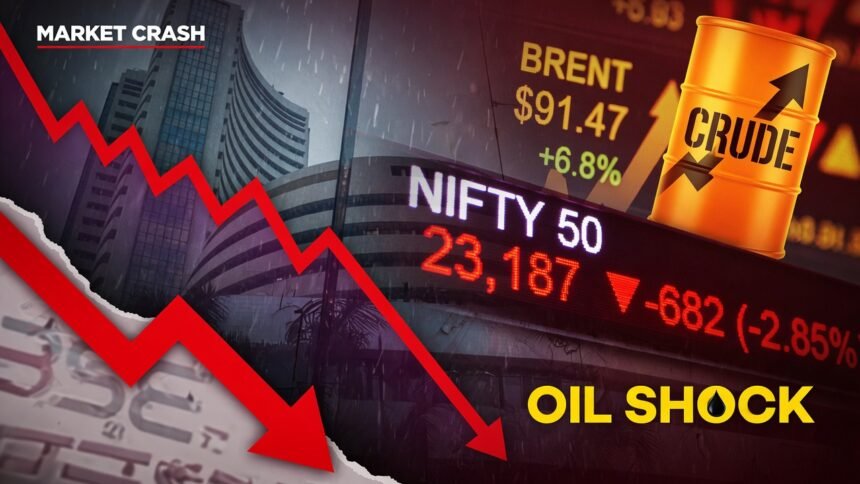
Indian Stock Market Crash: Nifty 50 Falls Below 23,200 as Crude Oil Surges
The Indian stock market crash intensified on Tuesday, September 15, as the Nifty 50 closed below the psychologically important 23,200 level amid rising crude oil prices, geopolitical tensions and higher global bond yields. The benchmark index ended at 23,118.60, down 279.50 points, or 1.19%, marking its lowest closing level in five months. The Sensex also fell sharply, declining 777.94 points, or 1.04%, to close at 74,003.82.
The sell-off came as investors reacted to a combination of elevated Brent crude prices, ongoing tensions in the Middle East and a sharp rise in U.S. Treasury yields. The combination has increased concerns about inflation, interest rates and India’s import costs.
Nifty 50 Breaches the 23,200 Level
The Nifty 50 had started Tuesday’s session on a stronger note, but the early gains quickly faded as selling pressure intensified during the trading day.
The index eventually closed at 23,118.60, firmly below the 23,200 mark. The decline also pushed the benchmark to its lowest closing level in five months.
The breach of the 23,200 level is significant from a market-technical perspective because traders often monitor major round-number levels as indicators of short-term sentiment.
The sell-off was not restricted to large-cap stocks. Broader market indices also experienced pressure, with mid-cap and small-cap stocks declining more sharply during the session.
Brent Crude Oil Remains Above $107
One of the biggest factors weighing on Indian equities has been the sharp rise in crude oil prices.
Brent crude had climbed to around $107-$108 per barrel as concerns about supply disruptions in the Middle East intensified. On September 16, Brent remained elevated at around $107.53 despite falling more than $1 from the previous session as U.S. inventory data provided some relief.
For India, sustained high crude prices can create broader economic concerns because the country relies heavily on imported crude oil.
Higher oil prices can increase the cost of transportation, fuel and other energy-intensive activities. They can also put pressure on the country’s import bill and inflation outlook.
This explains why a sharp oil-price rally can quickly become a major concern for Indian equity investors.
Middle East Conflict Adds to Market Uncertainty
The ongoing Middle East conflict has added another layer of uncertainty to global energy markets.
Recent supply disruptions involving Saudi Arabia have raised concerns about the security of oil infrastructure and transportation routes. Reuters reported that Saudi Arabia suspended oil loadings at Yanbu port after an attack affected its East-West pipeline.
The situation has also affected shipping activity in important regional routes, including the Strait of Hormuz and the Red Sea.
For financial markets, the concern is not limited to the immediate movement in crude prices. Investors are also assessing whether supply disruptions could persist for an extended period.
A prolonged period of expensive oil could create additional inflationary pressure across major economies.
Rising U.S. Bond Yields Add More Pressure
Crude oil was not the only concern facing global investors.
The U.S. 10-year Treasury yield moved above 5%, reaching levels not seen in many years. Higher U.S. yields can affect global financial markets because they influence borrowing costs and the attractiveness of dollar-denominated assets.
For emerging markets such as India, rising U.S. yields can contribute to greater volatility in equity and currency markets.
Investors were also awaiting the U.S. Federal Reserve’s policy decision, adding another major event to an already uncertain market environment.
Financial and Auto Stocks Face Heavy Selling
Several economically sensitive sectors came under pressure during the sell-off.
Financial stocks and automobile companies were among the sectors experiencing significant declines. Reuters reported that financials fell around 1.8%, while the auto sector dropped approximately 2% during Tuesday’s session.
These sectors can be particularly sensitive to economic expectations, interest rates and consumer demand.
When investors become concerned about inflation and borrowing costs, they often reassess companies whose earnings are closely linked to economic growth and consumer spending.
IT Stocks Provide Some Support
Information technology stocks performed relatively better during the market decline.
According to Reuters, the IT sector gained around 2.2% during Tuesday’s session, with companies including TCS and Infosys among the stocks providing some support to the broader market.
The relative resilience of IT stocks provided some diversification within the market, although it was not enough to prevent the benchmark indices from recording substantial losses.
The sector’s performance also reflected differences in how various parts of the Indian market respond to global macroeconomic developments.
Why Rising Oil Prices Matter for Indian Investors
India’s exposure to imported crude makes oil prices an important variable for the country’s economy and financial markets.
When crude prices rise sharply, several effects can emerge.
First, the country’s import bill can increase. Second, higher fuel and transportation costs can affect businesses and consumers. Third, persistent energy inflation can complicate monetary-policy decisions.
Companies with high fuel or transportation costs may face margin pressure if they cannot pass higher expenses on to customers.
On the other hand, some oil and energy-related businesses can benefit from higher commodity prices depending on their business models.
This creates different effects across sectors rather than a uniform impact on the entire market.
Sensex Also Records a Sharp Decline
The broader market weakness was reflected in the Sensex as well.
The 30-share index fell 777.94 points, or 1.04%, to close at 74,003.82 on Tuesday. The index also reached its lowest level in more than five months.
The simultaneous declines in the Sensex and Nifty reflected a broad deterioration in investor sentiment rather than weakness concentrated in just a handful of companies.
The decline also pushed India’s listed market capitalization below the $5 trillion mark, according to reporting from the Economic Times, highlighting the scale of the market correction.
Nifty 50 Sees Some Recovery on September 16
Despite the sharp decline on September 15, the market showed signs of recovery during Wednesday’s session.
Reuters reported that Indian shares opened higher on September 16, with the Nifty 50 and Sensex each gaining around 0.4% during morning trading before giving up part of their early gains.
Later market updates showed the Nifty moving back above 23,200 during mid-morning trading as crude prices paused their recent rally.
However, the recovery does not eliminate the broader concerns surrounding oil prices, global interest rates and geopolitical developments.
Global Markets Remain Under Pressure
Indian stocks were also influenced by weakness across international markets.
Wall Street ended lower on Tuesday, with the Dow Jones Industrial Average falling 0.63%, the S&P 500 declining 0.45% and the Nasdaq dropping 0.78%. The declines came as investors reacted to rising Treasury yields, expensive crude oil and concerns about inflation.
Asian markets also remained cautious as investors assessed the Federal Reserve’s upcoming decision and the continuing rise in energy prices.
The interconnected nature of global financial markets means that developments in U.S. bonds, crude oil and international equities can quickly influence Indian market sentiment.
What Investors Are Watching Now
The market’s next direction is likely to depend on several factors, including crude oil prices, developments in the Middle East and global interest-rate expectations.
Investors will also monitor whether the Nifty 50 can sustain its recovery above the 23,200 area after breaking below that level during Tuesday’s sell-off.
Market participants are additionally watching the Federal Reserve’s policy decision, as any change in expectations around U.S. interest rates could influence global risk appetite.
The immediate focus remains on whether the recent pressure proves temporary or develops into a longer period of market volatility.
Looking Ahead
The Indian stock market crash on September 15 highlighted how quickly global developments can affect domestic equities. The Nifty 50’s fall below 23,200 and five-month closing low came as investors dealt with a combination of expensive crude oil, Middle East supply concerns, rising U.S. Treasury yields and uncertainty around global monetary policy.
Wednesday’s early recovery above 23,200 showed that market sentiment can change quickly, particularly when crude prices stabilize. However, the broader risks remain relevant for investors as long as energy markets and global interest-rate expectations remain volatile.
For the Indian market, the trajectory of crude oil prices will remain particularly important because sustained high energy costs can influence inflation, corporate margins, the currency and economic growth expectations.
FAQs
1. Why did the Indian stock market fall sharply?
The sell-off was driven by a combination of elevated crude oil prices, Middle East tensions, rising U.S. Treasury yields and concerns about inflation and global interest rates.
2. Where did the Nifty 50 close on September 15, 2026?
The Nifty 50 closed at 23,118.60, down 279.50 points or 1.19%, marking a five-month low.
3. Why are high crude oil prices a concern for India?
India imports a significant amount of its crude oil requirements, so higher international oil prices can increase the import bill and create pressure on inflation and business costs.
4. What happened to Brent crude oil prices?
Brent crude remained above $107 per barrel amid supply concerns linked to disruptions in the Middle East. It later eased on September 16 after U.S. crude inventories increased unexpectedly.
5. Did the Nifty 50 recover after falling below 23,200?
Yes. On September 16, the Nifty 50 moved back above 23,200 during morning trading as crude prices paused their recent rally, although volatility remained elevated.
6. What are the key factors investors are watching now?
Investors are closely monitoring crude oil prices, Middle East developments, U.S. Treasury yields, the Federal Reserve’s policy decision and the Nifty 50’s ability to sustain its recovery.