In a historic shift for higher education, the Department of Philosophy and its pioneering Applied Philosophy Lab at Srikishan Sarda (S.S.) College have officially launched a comprehensive academic blueprint for the 2026–2027 Academic Session.
Under the departmental leadership of Associate Professor Jamir Ahmed Choudhury, Head of the Department and Architect of the Unerring Knowledge Framework (UKF), this institutional breakthrough marks a bold transition from abstract theory into observable natural science. Driven by a newly unveiled textbook curriculum and backed by mandatory undergraduate coursework, the lab has established an unyielding line dividing raw natural reality from consensus-based institutional errors.
The Structural Blueprint: Restoring the Cosmos to True Science
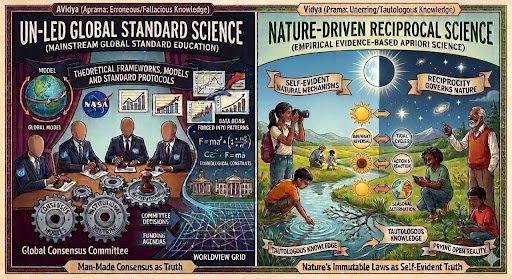
The conceptual framework of this intellectual frontier is defined by the sharp divide between Natural Mechanisms (True Science) and Man-Made Mechanisms (Technology). As stated on the lab’s newly authorized textbook blueprint:
“Human Consensus May Build an Umbrella, But It Can Never Alter the Absolute Law of the Rain. Subjective Conjectures of Finite Beings Fall Silent Before the Un-Falsifiable Reality of Pre-Existing Natural Law.”
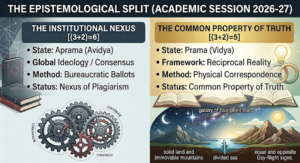
The lab’s curriculum systematically steps away from unverified textbook assumptions and rotating spheres. Instead, it anchors true knowledge (Pramā / Vidyā) within the un-falsifiable topography of a Stable Six-Direction Universe Model [SDG6], the Sirius Binary System, and the Algol Triple Star Mechanism. These physical anchors serve as universal proof that nature creates all its forces in balanced, equal, and opposite pairs—a reality verified by the absolute, continuous alteration of daylight time zones between the Eastern (EDTZ) and Western (WDTZ) zones.
Turning Philosophy into Action: The 2-Credit NEP 2020 Internship
To bring these principles into the public commons, the Applied Philosophy Lab has launched a mandatory 2-Credit Internship Plan for 5th Semester undergraduate students titled “Philosophy of Reciprocal Paradigm under NEP 2020.”
This experiential learning curriculum breaks down into two strictly monitored operational phases:
- Inside the Lab (45 Hours): Interns engage in rigorous textual audits, epistemological mapping, and psychometric engineering. Each student must build a repository of 30 context-based Binary-Option MCQs to evaluate content using absolute logical paths, satisfying the fear-free learning mandates of Section 29 of the RTE Act 2009.
- Out in the Field (15 Hours): Operating with the formal approval of the Office of the Inspector of Schools, Hailakandi, interns deploy to 5 local Junior Colleges and Higher Schools to pilot-test their evaluation templates and map out public cognitive clarity.
The internship features a strict, objective grading matrix out of 50 total marks: 60% weightage is given to the engineered lab portfolios, 20% to verified entries in the Indian Knowledge System (IKS) Field Log Book, and 20% to a final Socratic Viva-Voce defense.
The Interdisciplinary Add-on Course: Unerring Knowledge Framework
Complementing the internship is a new 30-Hour, 2-Credit Institutional Add-on Certificate Course open to undergraduate students across all Humanities, Social Sciences, and Pure Science streams. The syllabus trains the mind to use the UKF as a reliable truth-filter across four distinct units:
- Unit I: Nature’s Equal and Opposite Paradigm (7.5 Hours) – Establishes the Universal Major Premise (Vyāpti or Tawraat) using Newton’s Third Law and celestial binary configurations.
- Unit II: Observation of Particular Instances (7.5 Hours) – Formulates Affirmative Minor Premises (Pakṣadharmatā or Zabuur) by tracking natural signs(Hetu or Injiil), such as real-world environmental equilibrium, against textbook claims.
- Unit III: Structural Forms of Knowledge (7.5 Hours) – Isolates tautologous facts from self-contradictory claims (Apramā), applying Aristotle’s Dictum de Omni et Nullo to expose systemic textbook errors.
- Unit IV: Canons of Elimination and Verification (7.5 Hours) – Operationalizes diagnostic truth-filters via Descartes’ Method of Doubt, Mill’s Experimental Methods, four canons of elimination, and the four criteria of truth (Coherence, Correspondence, Pragmatic, and Self-evident).
Students master these filters through world-class literature, pairing standard texts like Copi and Cohen’s Introduction to Logic and D.M. Datta’s Six Ways of Knowing alongside Professor Jamir’s landmark capstone books, including Resurrection: Paradigm Shift, Academic Freedom: The Epistemological Revolution, and Inalienable Right to Tautologous Knowledge.
The Tri-Centric Justification and Constitutional Mandate
The introduction of this curriculum structure rests upon a rock-solid, integrated regulatory and legal framework:
- Section 2.5.3 of the NCF-2005: Mandates that the truth of scientific models must maintain a direct physical correspondence with the natural world rather than relying on ballot-based group consensus.
- Page 25 of the National Education Policy (NEP-2020): Mandates the deep integration of cognitive science and logical reasoning into undergraduate studies.
- Article 51A(h) of the Constitution of India: Executes the fundamental citizen duty to develop a scientific temper, humanism, and the spirit of inquiry and reform.
This educational movement operates under the permanent legal protection of the Court of the Chief Judicial Magistrate at Hailakandi (Case No. 162/2022), which formally recognized Professor Jamir as an academician and research worker making a lawful, secular, and humanistic appeal for systemic educational reform.
An International Invitation to Cognitive Liberty
To ensure that pure science remains the common property of humanity, Professor Jamir Ahmed Choudhury has issued a universal Declaration of the Cognitive Commons, formally waiving all corporate copyright restrictions on these natural facts. The human family is universally invited to copy, translate, print, and distribute the empirical apriori sciences across any territory without written permission.
The multi-year institutional silence from international educational boards—headlined by the National Academy of Sciences, India (NASI) formal written admission (Ref: NAS/716/3/017-18) that an expert response remains unavailable—records an absolute forensic default. The Applied Philosophy Lab has successfully cleared the path, inviting students and researchers alike to step past the UN-led global veil of ignorance (consensus-based global standard education) and align their intellects with the pre-existing equal & opposite laws of the upright rectangular universe. .
“YatoDharmastatoJayaḥ”
(Where there is Truth-based Law, there is Victory.)