S. Jaishankar UNGA Address: India Reaffirms Right to Defend Against Cross-Border Terrorism
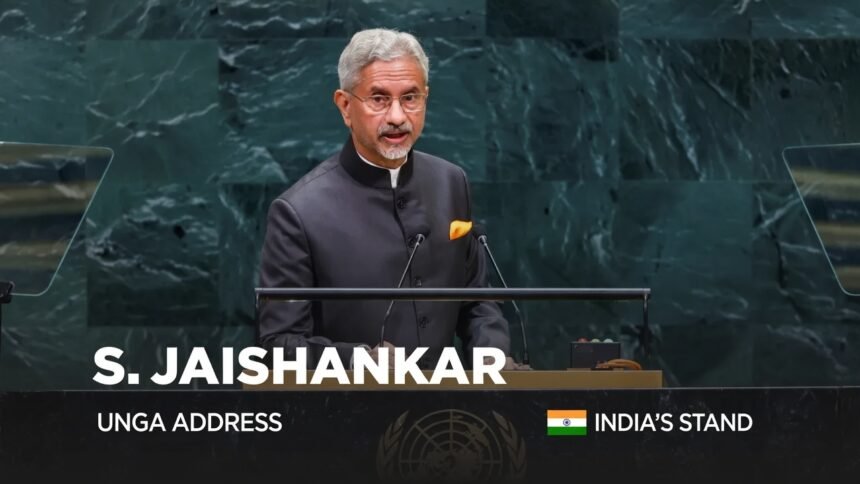
The S. Jaishankar UNGA address on September 26, 2026, placed cross-border terrorism, national security, maritime safety and the concerns of developing countries at the centre of India’s message to the United Nations General Assembly. Speaking during the General Debate of the 81st UNGA session in New York, External Affairs Minister S. Jaishankar said India would continue to exercise its right to defend itself against terrorism.
Jaishankar’s remarks came a day after Pakistan Prime Minister Shehbaz Sharif addressed the Assembly and raised issues including Kashmir and the Indus Waters Treaty. Without directly naming Pakistan in his speech, Jaishankar referred to a “serial practitioner of terrorism” and rejected attempts to normalise terrorism or claim immunity from its consequences.
Jaishankar Reaffirms India’s Security Position
A central message of the address was that terrorism remains a persistent threat to international peace, particularly when it has a state-sponsored and cross-border dimension.
Jaishankar said India’s right to defend itself against terrorism would be exercised and argued that governments involved in such practices should be held accountable. He also stressed that India would maintain a zero-tolerance approach towards terrorism and called for greater attention to terror-financing networks.
The statement reinforced India’s longstanding position that terrorism should not be separated from the responsibility of those who support, finance or facilitate it.
Cross-Border Terrorism and Accountability
Jaishankar linked cross-border terrorism to broader challenges facing the international system. He said attempts to normalise terrorism or seek immunity from its consequences would not stand.
India also called for the financial dimensions of terrorism to be exposed and countered. The emphasis on accountability reflects New Delhi’s continued push for international cooperation against terror financing and networks operating across borders.
The issue has remained a major component of India’s diplomatic messaging at the United Nations, where New Delhi has repeatedly called for consistent international action against terrorism and opposed what it describes as double standards in counter-terrorism efforts.
India Highlights Maritime Security
The S. Jaishankar UNGA address also went beyond terrorism and national security to highlight growing risks to commercial shipping and seafarers.
Jaishankar said attacks on commercial vessels and seafarers travelling through international waterways were “simply unacceptable”. He called on all sides involved in conflicts to exercise restraint, reduce tensions, protect civilians and ensure the uninterrupted movement of energy and commerce.
India has a significant seafaring workforce, and Jaishankar noted that Indian seafarers, along with workers from other countries, have lost their lives in attacks affecting maritime routes. He also pointed to security concerns stretching from the Gulf to the Red Sea and Black Sea.
Concerns Over the Impact of Global Conflicts
Jaishankar argued that countries far removed from conflict zones are increasingly facing economic and humanitarian consequences from wars in other regions.
He highlighted the impact of disruptions to shipping, energy supplies and international commerce, particularly on countries in the Global South. India called for restraint and de-escalation while stressing the need to protect civilians and maintain secure international waterways.
The message comes as geopolitical conflicts continue to affect trade routes, energy markets and supply chains beyond the immediate areas where fighting is taking place.
India’s Role in the Global South
Another element of the address was India’s emphasis on its role among developing countries and the broader Global South.
Jaishankar highlighted India’s humanitarian assistance and disaster-response efforts and presented India as a country seeking greater cooperation on development, capacity building and global challenges.
He also argued that international institutions need to reflect changing global realities, with a greater role for emerging and developing countries.
Jaishankar Raises Artificial Intelligence Concerns
Artificial intelligence also featured in India’s UNGA messaging.
Jaishankar highlighted both the opportunities and security implications of AI, including its potential impact on maritime operations. He said AI can support innovation and economic development but also create new challenges involving accountability and rapidly developing security situations.
India has increasingly positioned AI as a tool for economic growth and human development while also advocating international cooperation around emerging technologies.
India Calls for Greater Multilateral Cooperation
The address also reflected India’s broader position on reforming international institutions.
Jaishankar pointed to the changing global balance and argued for stronger multilateral cooperation. The UN itself has identified its 81st General Assembly as an opportunity to strengthen global cooperation and address challenges ranging from conflicts and development to technological change.
For India, the discussion includes reform of global institutions and a larger role for developing nations in international decision-making.
Why the UNGA Address Matters
The S. Jaishankar UNGA address brought together several of India’s major foreign-policy priorities: counter-terrorism, national security, maritime safety, protection of international commerce, Global South cooperation and responsible use of emerging technologies.
On terrorism specifically, India’s message was that cross-border and state-supported terrorism should not be normalised and that governments involved in supporting such activities should face accountability. At the same time, Jaishankar called for restraint and de-escalation in other ongoing conflicts, particularly where instability is affecting civilians and global trade.
The speech therefore combined a firm security position with calls for international cooperation, peaceful resolution of conflicts and stronger multilateral institutions.
Key Highlights of S. Jaishankar’s UNGA Address
- Jaishankar addressed the 81st UN General Assembly General Debate in New York on September 26, 2026.
- He reaffirmed India’s right to defend itself against terrorism.
- He criticised attempts to normalise terrorism or claim immunity from its consequences.
- India called for accountability for governments supporting state-sponsored, cross-border terrorism.
- Jaishankar reiterated India’s zero-tolerance approach to terrorism and highlighted the need to counter terror financing.
- He described attacks on commercial shipping and seafarers in international waterways as unacceptable.
- India called for restraint, de-escalation and protection of civilians amid ongoing conflicts.
- He highlighted the wider economic impact of conflicts on countries far from battle zones.
- AI, maritime security and emerging technology risks also featured in India’s messaging.
- India reiterated its focus on cooperation with the Global South and reform of international institutions.
Frequently Asked Questions
1. What did S. Jaishankar say at the UN General Assembly in 2026?
S. Jaishankar reaffirmed India’s right to defend itself against terrorism and called for accountability for governments supporting state-sponsored and cross-border terrorism.
2. Did Jaishankar directly name Pakistan in his UNGA speech?
No. He did not directly name Pakistan in the relevant portion of his speech but referred to a “serial practitioner of terrorism” following Pakistan Prime Minister Shehbaz Sharif’s UNGA address the previous day.
3. What was India’s position on cross-border terrorism?
India reiterated that cross-border terrorism remains a serious threat to peace and that governments supporting such activity should be held accountable.
4. What did Jaishankar say about India’s right to self-defence?
He said India’s right to defend itself against terrorism would be exercised, while stressing that terrorism cannot coexist with friendship and goodwill.
5. What did India say about terror financing?
Jaishankar called for the financial aspects of terrorism to be exposed and countered as part of India’s zero-tolerance approach.
6. What did Jaishankar say about attacks on ships?
He said targeting commercial shipping and seafarers travelling through international waterways was unacceptable and called for the protection of civilians and uninterrupted commerce.
7. Why is maritime security important for India?
India relies heavily on international maritime routes for trade and has a large community of seafarers. Disruptions to shipping can therefore affect trade, energy supplies and Indian workers.
8. Did Jaishankar discuss artificial intelligence?
Yes. He highlighted AI’s potential as well as security and accountability challenges, including risks associated with AI-driven maritime operations.
9. What is India’s position on the Global South?
India continues to advocate stronger cooperation with developing countries, including through development assistance, capacity building and greater representation in international institutions.
10. When did Jaishankar deliver the 2026 UNGA address?
Jaishankar delivered India’s national statement during the General Debate of the 81st United Nations General Assembly in New York on September 26, 2026. The UN’s 81st-session high-level week ran from September 18 to September 28.