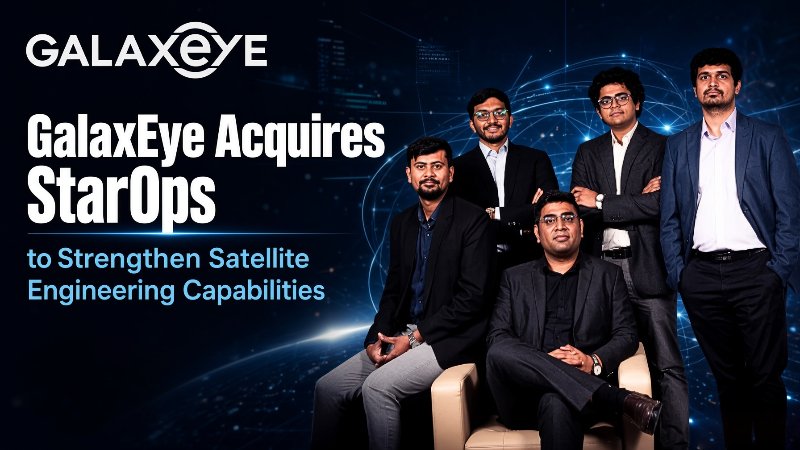
GalaxEye Acquires StarOps to Strengthen Satellite Engineering Capabilities
India’s deeptech and spacetech ecosystem is witnessing increasing strategic activity as startups look to strengthen their technology and engineering capabilities.
Bengaluru-based spacetech startup GalaxEye has acquired StarOps, a spacecraft engineering company, to expand its in-house satellite development and Earth Observation capabilities.
The acquisition will bring StarOps’ engineering expertise, spacecraft platforms and indigenous technologies into GalaxEye, allowing the company to build stronger end-to-end space mission capabilities.
Why Did GalaxEye Acquire StarOps?
The acquisition is aimed at strengthening GalaxEye’s capabilities beyond satellite payload development.
StarOps brings expertise across spacecraft engineering and satellite development, including areas such as propulsion, avionics, flight computing, guidance and navigation, structures and mission operations.
By bringing these capabilities in-house, GalaxEye can gain greater control over the design, development and integration of its future satellite missions.
This could also help the company reduce its dependence on external engineering partners as it scales its Earth Observation business.
StarOps Brings Satellite Engineering Expertise
StarOps was incorporated in 2022 and traces its origins to TeamIndus, one of India’s early private space ventures.
Several members of the StarOps engineering team have experience from the TeamIndus lunar programme, giving the company expertise across different aspects of spacecraft development.
The acquisition therefore gives GalaxEye access not only to technology but also to an experienced spacecraft engineering team.
Acquisition Adds Multiple Satellite Platforms
One of the major advantages of the deal is StarOps’ existing satellite platform capabilities.
The company has qualified satellite platforms across the 50 kg, 150 kg and 250 kg classes. StarOps has also achieved more than 66% indigenisation across its satellite systems and technologies.
These capabilities could help GalaxEye accelerate the development of future spacecraft and strengthen its ability to build more of its satellite systems within India.
GalaxEye’s Focus on Earth Observation
GalaxEye is developing next-generation Earth Observation technology through its proprietary OptoSAR approach.
The company’s technology combines Synthetic Aperture Radar (SAR) and optical imaging capabilities to provide Earth imagery across different weather and lighting conditions.
Its Mission Drishti satellite was designed around this technology and launched in May 2026.
The acquisition of StarOps could help GalaxEye strengthen the spacecraft engineering layer supporting its Earth Observation payloads.
Building End-to-End Space Capabilities
The StarOps acquisition reflects a broader strategy of building more capabilities internally.
Instead of focusing only on the payload and relying heavily on external partners for spacecraft systems, GalaxEye can now bring more parts of the satellite development process under one organisation.
This includes spacecraft design, engineering, system integration and mission operations.
Greater vertical integration could help the company improve control over development timelines and future mission requirements.
Acquisition Comes After Mission Drishti Setback
The deal also comes after GalaxEye faced a setback with Mission Drishti.
The company lost communication with the satellite following a severe geomagnetic solar storm in July and said the likelihood of recovery appeared low.
The company had described Mission Drishti as an important step in demonstrating its OptoSAR technology.
The StarOps acquisition now adds additional spacecraft engineering expertise as GalaxEye works toward its next phase of satellite development.
What Does This Mean for India’s Spacetech Sector?
The acquisition is another example of strategic consolidation within India’s emerging private space ecosystem.
As Indian spacetech startups move from technology development toward commercial missions, access to specialised engineering talent and proven spacecraft platforms is becoming increasingly important.
Acquisitions can allow companies to obtain these capabilities faster than building every function internally from scratch.
For the broader ecosystem, such deals could accelerate the development of India’s private satellite manufacturing and Earth Observation capabilities.
India’s Deeptech M&A Activity Is Growing
The GalaxEye-StarOps deal also highlights a broader trend in India’s deeptech ecosystem.
Startups are increasingly looking beyond traditional fundraising and partnerships to acquire technology, intellectual property, engineering talent and specialised capabilities.
For companies operating in complex sectors such as space technology, strategic acquisitions can provide a faster route to building sophisticated technical capabilities.
This could become increasingly important as India’s private space sector expands.
What Happens Next?
GalaxEye is expected to use StarOps’ engineering capabilities to strengthen its future satellite programmes and Earth Observation ambitions.
The integration of StarOps’ team, spacecraft platforms and technologies could help GalaxEye move toward more vertically integrated space missions.
The company will also need to demonstrate that the combined capabilities can translate into successful satellite missions and commercially viable Earth Observation services.
Final Thoughts
GalaxEye’s acquisition of StarOps marks an important strategic move for India’s growing spacetech ecosystem.
The deal gives GalaxEye access to satellite engineering expertise, spacecraft platforms and indigenous technologies, strengthening its ability to develop more end-to-end space missions.
For GalaxEye, the focus now shifts toward integrating StarOps’ capabilities and applying them to its future Earth Observation missions.
For India’s private space sector, the acquisition highlights how strategic M&A can help deeptech companies quickly build specialised capabilities and move closer to large-scale commercial deployment.
Frequently Asked Questions
What did GalaxEye acquire?
GalaxEye has acquired StarOps, a Bengaluru-based spacecraft engineering company with expertise in satellite platforms and spacecraft technologies.
Why did GalaxEye acquire StarOps?
The acquisition is intended to strengthen GalaxEye’s satellite engineering, spacecraft development and Earth Observation capabilities.
What capabilities does StarOps bring?
StarOps brings expertise in areas including propulsion, avionics, flight computing, guidance and navigation, structures and mission operations.
What satellite platforms does StarOps have?
StarOps has qualified satellite platforms in the 50 kg, 150 kg and 250 kg classes.
What is GalaxEye’s main technology?
GalaxEye is developing OptoSAR technology, which combines radar and optical sensors for Earth Observation.
What happened to GalaxEye’s Mission Drishti?
GalaxEye lost communication with Mission Drishti after a severe geomagnetic solar storm affected the spacecraft. The company later said recovery appeared unlikely.
What does the acquisition mean for India’s spacetech sector?
The deal demonstrates how Indian deeptech companies are using strategic acquisitions to strengthen engineering capabilities, technology and in-house development as the private space industry expands.