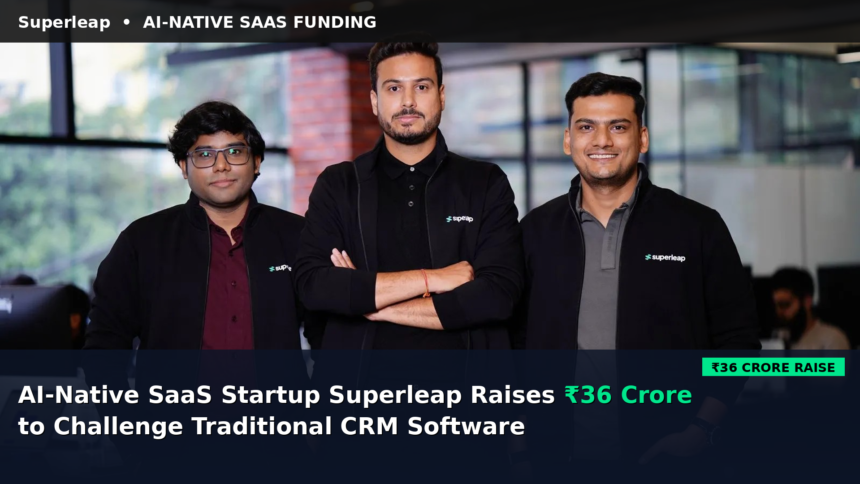
The Software-as-a-Service (SaaS) industry is entering a new era. Superleap, an AI-native CRM startup, has raised ₹36 crore in a pre-Series A funding round led by Peak XV’s Surge. Unlike traditional software companies that are adding AI features to existing products, Superleap has been designed as an AI-native platform, with generative AI built into its core architecture from the very beginning.
The funding reflects a larger shift across the software industry. Businesses are increasingly looking for AI-first platforms that can automate complete workflows instead of simply assisting users with individual tasks.
What Is an AI-Native SaaS Platform?
An AI-native SaaS platform is built around artificial intelligence from day one.
Unlike legacy software, where AI is often introduced as an additional feature, AI-native applications are designed so that artificial intelligence becomes the primary interface and decision engine.
This allows software to:
- Perform tasks automatically
- Understand natural language
- Generate content
- Analyze customer data
- Recommend actions
- Execute business workflows with minimal manual input
The result is software that actively works alongside users rather than simply providing tools.
Why Legacy SaaS Companies Face New Competition
Traditional SaaS platforms were built before the rise of generative AI.
Many established software providers are now integrating AI through updates and plugins, but their underlying architecture often remains unchanged.
AI-native startups take a different approach by designing every feature around automation from the start.
This enables:
- Faster workflows
- Smarter recommendations
- Reduced manual work
- Better user experiences
- Continuous learning through AI
For customers, the difference is not just new features but an entirely new way of interacting with business software.
How AI Is Changing CRM Software
Customer Relationship Management (CRM) systems have traditionally required employees to manually update records, manage pipelines, and prepare reports.
AI-native CRM platforms can automate many of these activities, including:
- Recording customer interactions
- Writing meeting summaries
- Drafting follow-up emails
- Prioritizing sales opportunities
- Forecasting revenue
- Recommending next actions
This allows sales and customer success teams to spend more time building relationships instead of handling administrative tasks.
Why Investors Are Betting on AI-First Software
The ₹36 crore funding round led by Peak XV’s Surge reflects growing investor confidence in AI-native software companies.
Investors see several advantages:
- Higher productivity for customers
- Faster product adoption
- Strong recurring subscription revenue
- Greater scalability
- Lower operational costs for businesses
As enterprises accelerate AI adoption, demand for intelligent software platforms is expected to grow rapidly.
AI-Native SaaS Is Redefining Enterprise Software
The next generation of enterprise software is moving beyond simple automation.
Modern AI-native platforms aim to:
- Understand business context
- Make recommendations
- Complete routine tasks
- Improve decision-making
- Continuously optimize workflows
Instead of asking users to operate software manually, the software increasingly performs work on behalf of the user.
This represents one of the biggest shifts in SaaS since the rise of cloud computing.
Opportunities and Challenges
While AI-native software offers significant advantages, companies also face important challenges.
These include:
- Data privacy and security
- AI accuracy
- Regulatory compliance
- Customer trust
- Integration with existing enterprise systems
Success will depend on balancing automation with reliability and transparency.
What This Means for India’s SaaS Ecosystem
India has already established itself as a global SaaS hub.
The emergence of AI-native startups suggests the next wave of growth will come from companies building products specifically for the AI era rather than adapting older software models.
This could strengthen India’s position in enterprise technology while creating globally competitive software products designed around artificial intelligence.
Final Thoughts
The Superleap AI-native SaaS funding round highlights how enterprise software is evolving beyond traditional cloud applications. By building generative AI into its CRM platform from the ground up, Superleap represents a new generation of startups focused on complete workflow automation rather than incremental software improvements.
As businesses demand smarter, faster, and more autonomous software, AI-native platforms are expected to play a central role in shaping the future of SaaS. The companies that build with AI at their core, rather than treating it as an add-on, could define the next decade of enterprise technology.
FAQ
What is Superleap?
Superleap is an AI-native CRM startup that has raised ₹36 crore in a pre-Series A funding round led by Peak XV’s Surge.
What does AI-native SaaS mean?
AI-native SaaS refers to software built around artificial intelligence from the beginning, with AI integrated into the platform’s core architecture rather than added later as a feature.
How is AI-native software different from traditional SaaS?
Traditional SaaS platforms often add AI capabilities to existing systems, while AI-native software uses AI to automate workflows, make decisions, and improve user productivity from the ground up.
Why are investors interested in AI-native startups?
AI-native platforms offer automation, productivity gains, recurring subscription revenue, and strong growth potential as businesses increasingly adopt AI-powered software.
How will AI change CRM software?
AI can automate customer data entry, generate meeting summaries, prioritize leads, draft emails, forecast sales, and recommend actions, allowing teams to focus more on customer relationships.